
Uncategorized

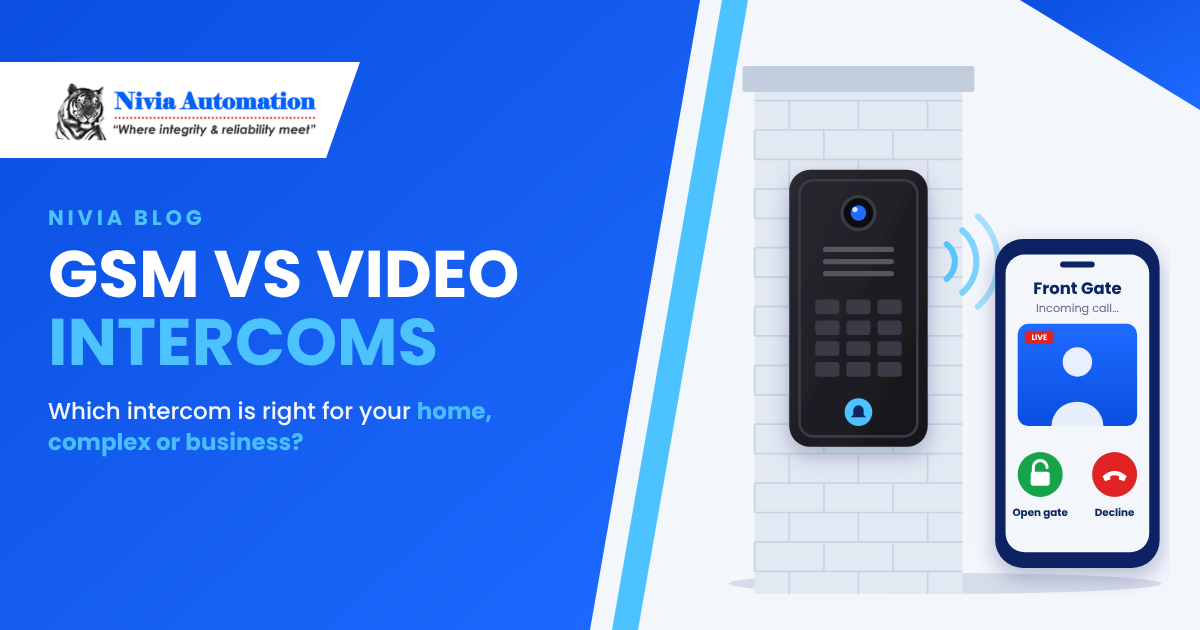
Intercom Systems: GSM vs Video vs Audio – Which Is Right for Your Home?

Your intercom is the first thing a visitor touches at your gate. A good one lets you see or speak to whoever is outside before you open up. A faulty one leaves people hooting in the street, or worse, lets the wrong person in.

There are three main types of intercom systems in South Africa: audio, video and GSM. Each suits a different kind of property. This guide explains how they work and which one makes sense for your home, complex or business.

1. Audio intercoms

An audio intercom is the classic setup: a speaker unit at the gate, wired to a handset inside the house. A visitor presses the button, you answer on the handset and press a button to open the gate.

  • Best for: homes where someone is usually indoors.
  • Pros: affordable, simple and reliable.
  • Cons: you can’t see who is at the gate, and you can only answer from inside the house.

2. Video intercoms

A video intercom adds a camera at the gate and a screen indoors, so you can see the visitor before you speak to them or let them in. Many newer models also connect to Wi-Fi, so you can answer and open the gate from an app on your phone.

  • Best for: family homes, complexes and offices where you want to see who’s there.
  • Pros: you can identify visitors, many models record snapshots or video, and app models work away from home.
  • Cons: costs more and needs cabling (and Wi-Fi for app control).

3. GSM intercoms

A GSM intercom works like a cellphone at your gate. It takes a SIM card, and when a visitor presses the button it calls your phone. You speak to them and open the gate from wherever you are, at work, on holiday or in the back garden.

  • Best for: properties with a long driveway, homes where nobody is in during the day, small businesses and farms.
  • Pros: no cable to the house, answer from anywhere, and authorised numbers can often open the gate with a call.
  • Cons: needs good cellphone signal at the gate and a SIM with airtime or a contract.

Intercom comparison at a glance

Audio Video GSM
See the visitor No Yes No (audio only)
Answer away from home No App models only Yes
Cable to the house Yes Yes No
Running cost None None (Wi-Fi for app) SIM airtime / contract
Ideal for Budget homes Homes, complexes, offices Busy homeowners, long driveways, businesses

Which intercom is right for you?

Freestanding home

If someone is home most of the day, a video intercom gives you the most peace of mind. If the house is often empty, or the gate is far from the front door, a GSM intercom means you never miss a delivery or a visitor.

Townhouse complex or estate

Complexes need a multi-unit system where each unit has its own button and indoor station or phone number. Video intercoms linked to access control (tags, keypads or remotes) give the best control over who comes in.

Office, warehouse or farm

GSM intercoms are popular here because there is no long cable run to install. Calls can go to reception, a manager or a rotating list of numbers.

What to check before you buy (South African tips)

  • Loadshedding: make sure the intercom and gate motor have a battery backup, so you can still answer and open the gate when the power goes off.
  • 2G and 3G switch-off: networks are phasing out 2G and 3G. If you’re choosing a GSM intercom, go for a 4G/LTE model so it keeps working.
  • Signal at the gate: test cellphone signal at the exact spot the GSM unit will go. A weak signal means dropped calls.
  • Lightning and surges: cables between the gate and the house can carry surges into your intercom and gate motor. Surge protection and proper earthing help prevent damage during summer storms.
  • Works with your gate motor: your intercom should trigger your existing gate motor cleanly. Our technicians check this as part of every installation.

Signs your intercom needs a repair or upgrade

  • Crackling, faint or one-way audio
  • The gate doesn’t open when you press the release button
  • A blurry or blank video screen
  • Your GSM intercom has stopped calling, or calls drop
  • Faded or broken buttons, or water damage to the gate unit

Many faults are quick fixes, such as a battery, a connection or a weather-damaged button. If your unit is old or 2G/3G-only, an upgrade is often better value than repeated repairs.

Intercom installation and repairs by Nivia Automation

Nivia Automation has installed and maintained intercom systems since 2004. We supply, install and repair audio, video and GSM intercoms for homes, complexes and businesses, using our own trained technicians in Johannesburg, Durban and Cape Town, not subcontractors.


Need a new intercom or a repair?

Call your nearest branch or request a free quote.

Johannesburg: (011) 485 1792  |  Durban / KZN: (031) 409 3718  |  Cape Town: (021) 633 0507


Frequently asked questions

What is a GSM intercom?

A GSM intercom uses a SIM card instead of cables to the house. When a visitor presses the button at the gate, it calls your cellphone (or a list of numbers), so you can talk to them and open the gate from anywhere you have signal.

Do GSM intercoms work during loadshedding?

The intercom keeps working if it has a battery backup, which we fit as standard. During long outages some cellphone towers can lose power, so calls may drop in certain areas. A gate motor and intercom on good batteries give you the best chance of staying connected.

Can I open my gate from my phone?

Yes. GSM intercoms let you open the gate during a call or, on most models, by calling the unit from an authorised number. App-based video intercoms let you see the visitor and open the gate from the app.

Will my old GSM intercom stop working when 2G and 3G are switched off?

It might. South African networks are phasing out 2G and 3G, so older units that only support those networks can lose service. We can check your unit and upgrade it to a 4G/LTE model if needed.

Do you install intercoms for complexes, estates and offices?

Yes. We install multi-unit intercom systems for townhouse complexes, estates and commercial buildings, including video intercoms linked to access control.

Do you repair intercoms you did not install?

Yes. Our own technicians repair and service most common intercom brands in Johannesburg, Durban and Cape Town.
Gate Automation

Gate Motor Installation Cost SA

Thinking about automating your gate, or replacing a motor that keeps failing? The first question most homeowners ask is simple: how much will it cost? This guide gives you realistic 2026 price ranges for gate motor installation in South Africa, explains what is included, and shows which factors push the price up or down. That way you can compare quotes properly and avoid surprises.

Quick answer

Most South African homes pay roughly R8,000 to R15,000 to have a residential sliding gate motor supplied and installed. Swing gate motors usually cost more, especially for double gates. Labour alone typically ranges from about R1,500 to R5,000, depending on how much work the site needs.

Gate motor installation cost in South Africa: 2026 price guide

The table below shows typical market ranges, including VAT. Your own price depends on your gate, your property and the motor you choose, so treat these figures as a guide rather than a quote.

Installation type Typical cost (supplied & installed)
Residential sliding gate motor (e.g. Centurion D5 Evo, ET Drive) R8,000 – R15,000
Single swing gate motor R9,000 – R12,000
Double swing gate motors (pair) R13,000 – R20,000+
Heavy-duty / commercial sliding motor (e.g. Centurion D10) R15,000 – R25,000+
Labour only (you already have the motor) R1,500 – R5,000

Prices are indicative market ranges for 2026 and change with supplier pricing. A site visit is the only way to get an exact figure.

What a standard gate motor installation includes

When you compare quotes, check that each one covers the same items. A proper residential sliding gate installation normally includes:

  • The gate motor and its control card
  • A base plate or foundation for the motor
  • Gear rack fitted along the length of the gate
  • A backup battery so the gate works during loadshedding
  • Two remotes, coded to the motor
  • Connection to an existing power point near the gate
  • Setting the open and close limits, speed and safety settings
  • Testing and a handover, so you know how to use the system

Anything outside this list, such as new cabling, trenching, safety beams or an intercom, is usually quoted as an extra.

7 factors that affect the price of your gate motor

1. Sliding or swing gate

Sliding gates need one motor and a rack, so they are usually the cheaper option. Swing gates need a motor per leaf, which is why a double swing gate costs noticeably more.

2. Gate weight and length

Every motor has a maximum gate weight. For example, the Centurion D5 Evo SMART is rated for sliding gates up to 500kg. A heavy steel gate may need a stronger, more expensive motor. Choosing a motor that is too small leads to strain, overheating and early failure.

3. Brand and model

Established brands such as Centurion, Nice, Hansa and ET cost a little more upfront. However, spares are easy to find, so repairs stay quick and affordable for years. Read our guide to choosing the right gate motor for a full comparison.

4. Power supply to the gate

If there is already a plug point close to the gate, installation is simple. If an electrician needs to run new cable or dig a trench across the driveway, expect the cost to go up.

5. The condition of your gate

A motor can only move a gate that runs smoothly. Worn wheels, a bent track or a gate that sags will need fixing first. Skipping this step is one of the main reasons new motors fail early.

6. Battery backup

All residential motors include a standard battery, but homes with long power outages often upgrade to a bigger battery or add solar. Our article on how long a gate motor battery lasts explains what size you need.

7. Security and convenience extras

Popular add-ons include an anti-theft bracket, safety beams, extra remotes, a keypad, a GSM module to open the gate from your phone, an intercom and surge protection. In summer storm season, surge protection is well worth it. See our guide to protecting your motor from lightning damage.

Repair or replace: is a new motor worth it?

A new motor is not always the answer. Many faults, such as a flat battery, a worn pinion or a faulty receiver, can be fixed for far less than a new installation. If your gate remote is not working, for example, the problem is often a cheap fix.

Replacing the motor usually makes sense when:

  • The motor is old and spares are no longer available
  • You are paying for repairs several times a year
  • Lightning or a power surge has damaged the control card and motor
  • Your gate is heavier than the motor is rated for
  • You want smart features, such as app control or diagnostics

Not sure which option is right? Our article on common gate motor problems and solutions can help you decide.

Hidden costs to watch for in a cheap quote

A low price can turn expensive if important items are missing. Before you accept a quote, check for these:

  • No anti-theft bracket. Gate motors are a common target for theft, so an unprotected motor is a risk.
  • Unknown brand. Cheap imported motors can be hard to repair because spares are scarce.
  • Undersized battery. Your gate may stop working halfway through a long outage.
  • Gate repairs left out. If the gate does not run smoothly, the new motor will struggle.
  • Subcontracted labour. Ask who will actually do the work and who you call if something goes wrong.
  • Call-out and travel fees. Check whether these are included or charged separately.

How to get an accurate gate motor quote

You can speed up your quote by sending us a few details:

  1. Is your gate sliding or swing? Single or double?
  2. Roughly how wide is it, and is it steel, aluminium or wood?
  3. Is there a plug point near the gate?
  4. Do you have an existing motor? If so, which brand?
  5. Two or three photos of the gate, track and motor area

A Nivia technician then checks the gate on site, and you get a clear written quote before any work starts.

Gate motor installation in Johannesburg, Durban and Cape Town

Nivia Automation has installed and repaired gate motors since 2004. Unlike many installers, we never send subcontractors. Every job is done by our own technicians, who carry spares for Centurion, Nice, Hansa and ET motors, so most repairs are finished on the first visit.

Frequently asked questions

How much does it cost to install a gate motor in South Africa?

Most homes pay roughly R8,000 to R15,000 for a residential sliding gate motor, supplied and installed. Swing gates, heavy gates and extras such as safety beams or an intercom increase the price.

Is installation included in the price of a gate motor?

Not always. Online and retail prices are usually for the motor or kit only. Professional installation typically adds R1,500 to R5,000, depending on the work needed.

How long does a gate motor installation take?

Most standard sliding gate installations are completed in a day. Jobs that need gate repairs, new cabling or trenching can take longer.

Can I install a gate motor myself?

It is possible, but we do not recommend it. Manufacturers state that motors should be installed by a suitably qualified technician. Incorrect setup can damage the motor, void the warranty and create a safety risk, especially with the gate’s force and obstacle settings.

Will my gate motor work during loadshedding?

Yes. Gate motors run off a backup battery, so they keep working when the power is off. If your gate slows down or stops during long outages, the battery may need replacing or upgrading.

Get a clear, written gate motor quote

Tell us about your gate and we will send a technician from our Johannesburg, Durban or Cape Town team. No subcontractors, no surprises.

Johannesburg: (011) 485 1792  |  Durban: (031) 409 3718  |  Cape Town: (021) 633 0507
After hours: 087 805 9781

Motor Repairs

Gate Motor Lightning Damage: How to Protect Your Motor


Quick answer: Most gate motor lightning damage doesn’t come from a direct strike. It comes from a power surge travelling through the mains cable, the underground wiring or the earth. Proper earthing, surge protection and a healthy battery backup are the best defence. If your gate stops working after a storm, switch off the power at the isolator and call a technician before resetting anything.

Summer storm season is here. From October to March, afternoon thunderstorms roll across Johannesburg, Pretoria and much of KwaZulu-Natal, and every year we see the same thing: gate motors that worked perfectly in the morning are dead by evening. Here’s what causes gate motor lightning damage, how to spot it and how to protect your motor before the next storm.


How lightning damages a gate motor

A gate motor sits outside, at the end of a long cable run, often close to an electric fence and a metal gate. That makes it an easy path for a power surge. Damage usually happens in one of three ways:

  • Mains surge: a strike on nearby power lines sends a spike down the cable that feeds your motor’s charger.
  • Ground surge: a strike close to your property raises the voltage in the soil, which travels through the earth and into buried cables.
  • Induced surge: a nearby strike creates a surge in long cable runs, such as intercom, keypad and safety beam wiring.

The parts that suffer most are the control card (the motor’s “brain”), the battery charger and the remote receiver. The motor itself often survives.


Signs of gate motor lightning damage

After a storm, look out for:

  • The gate won’t open or close at all, even on battery power
  • Remotes have stopped working, but the motor still hums or clicks
  • The status light on the control card is off, flashing an unusual pattern, or the card smells burnt
  • The battery isn’t charging and runs flat within a day or two
  • The intercom, keypad or safety beams stopped working at the same time
  • Your electric fence energiser also went off during the storm

How to protect your gate motor from lightning

Protection What it does
Proper earthing Gives a surge a safe path into the ground instead of through your electronics
Surge protection on the mains supply Absorbs spikes before they reach the charger and control card
Surge protection on low-voltage cables Protects the control card from surges on intercom, keypad and beam wiring
A healthy battery Keeps the gate running when the power trips during a storm
Regular servicing Picks up corroded connections and failing parts before a storm finds them

A few habits help too:

  1. Check your earthing. A loose or corroded earth connection leaves your motor unprotected. Our technicians check it as part of every service.
  2. Ask about surge protection. Your existing motor can often be fitted with surge protection, which costs far less than a new control card.
  3. Look after your battery. A weak battery means you can’t open the gate when the power fails mid-storm. Read our guide on how long a gate motor battery lasts.
  4. Keep the area clear. Water pooling around the motor base and ants nesting inside the cover both cause faults that storms make worse.
  5. Switch off before a big storm if you’re away. If you’re leaving for the holidays, switching off the motor’s mains isolator removes one route for a surge. The battery will still run the gate for a while.

What to do if your gate motor is hit by lightning

  1. Switch off the power at the isolator before touching the motor. Water and surge damage can make parts live.
  2. Don’t keep resetting it. Repeated attempts on a damaged control card can make things worse.
  3. Open the gate manually using the release key so you can get in and out safely.
  4. Take photos of the motor, the control card and any burn marks.
  5. Call a technician. We’ll test the control card, charger, battery and receiver and tell you what needs replacing.

For other faults, see our guide to common gate motor problems and solutions.


Is gate motor lightning damage covered by insurance?

Manufacturer warranties usually exclude lightning and power-surge damage. Many household and building insurance policies do cover it, but check your policy. Your insurer will normally ask for a technician’s report confirming the cause of the damage and a quote for the repair. We can provide both.


Frequently asked questions


Can lightning damage a gate motor if it doesn't hit the house?

Yes. Most gate motor lightning damage comes from power surges through the power lines or the ground after a strike nearby, not from a direct hit.


Will a battery backup protect my gate motor from lightning?

No. A battery keeps the gate working during power cuts, but it doesn’t stop a surge. You need proper earthing and surge protection for that.


Do I need a new gate motor after a lightning strike?

Not always. Often only the control card, charger or receiver needs replacing. We carry spares for Centurion, Nice, Hansa and ET motors, so most repairs are done on the first visit.


Is gate motor lightning damage covered by insurance?

Manufacturer warranties usually exclude it, but many household and building policies cover lightning and power-surge damage. Your insurer will normally ask for a technician’s report and a repair quote, which we can provide.


Can you repair my gate motor after hours?

Yes. For urgent faults outside office hours (Monday to Friday, 8am to 5pm), call our after-hours line on 087 805 9781.


Get your gate motor storm-ready

Nivia Automation’s own technicians install, repair and service gate motors in Johannesburg, Durban and Cape Town. Book a service before the storms peak, or call us if your motor has already been hit.
Johannesburg: (011) 485 1792
Durban: (031) 409 3718
Cape Town: (021) 633 0507
After hours: 087 805 9781


Battery Replacement

How Long Does aGate Motor Battery Last?

How Long Does a Gate Motor Battery Last?

Quick answer: In South Africa, most gate motor batteries last between 1 and 3 years, with 2 years being a realistic average. Frequent load shedding shortens that further, often down to 18–24 months, because every power cut forces the battery through another full charge cycle. The motor itself can easily last 8–15 years — it’s almost always the battery that needs attention first.

Why the battery wears out long before the motor

Most gate motors — including the Centurion, ET Nice, Hansa, and Nice systems we install and service — are actually designed to run primarily off the battery, even when mains power is available. The transformer’s job is simply to keep that battery topped up. So the battery isn’t just a “backup” for load shedding — it’s doing the work every single time your gate opens.

A standard sealed lead-acid battery has a design life of roughly 150 charge cycles. Under stable power, that can take a couple of years to use up. But every load shedding outage counts as a full charge cycle of its own. At two outages a day, that 150-cycle lifespan can be used up in a matter of months during heavy load shedding periods — which is why so many gate batteries in South Africa die well before homeowners expect them to.

What type of battery does your gate motor use?

Most residential gate motors use a 12V sealed lead-acid (SLA) or gel battery, typically rated at 7Ah or 8Ah. Larger sliding gate motors built for heavier gates (like the Centurion D6 or D10) run on 24V and use two batteries wired together.

  • Sealed lead-acid (SLA): the most common, most affordable option, but the least tolerant of repeated deep discharging from load shedding.
  • Gel batteries: a step up in durability, generally better suited to frequent charge cycles.
  • Lithium-ion (LiFePO4): higher upfront cost, but can significantly outlast lead-acid or gel batteries and copes far better with heavy load shedding cycling — often the better long-term value in areas with frequent outages.

What affects how long your gate motor battery lasts

  • Frequency of use — the more your gate opens and closes each day, the faster the battery wears
  • Load shedding and power cuts — every outage is another full discharge/recharge cycle
  • Heat — a motor housing that sits in direct sun ages the battery faster than one in the shade
  • Battery type — SLA, gel, and lithium batteries all age differently under the same conditions
  • Maintenance — clean terminals and secure connections go a long way toward getting a battery’s full expected life

Signs your gate motor battery needs replacing

  • The gate opens or closes noticeably slower than it used to
  • The gate stops partway and doesn’t fully open or close
  • The gate only works while mains power is on, and stops completely during load shedding
  • The remote works, but the gate is slow or hesitant to respond
  • The motor makes a clicking sound but the gate doesn’t move

If any of these sound familiar, it’s worth having the battery checked before it fails completely — usually at the worst possible time, like being locked out during load shedding.

How load shedding affects your gate motor battery

Because every outage forces a full charge cycle, the stage of load shedding your area experiences has a direct, measurable effect on how long your battery lasts:

Load shedding level Typical battery lifespan
Light / occasional 24–36 months
Frequent 18–24 months
Heavy daily cycling (e.g. high-traffic complex gates) Often under 18 months

How to get more life out of your gate motor battery

  • Keep the battery terminals clean and the connections tight — corrosion is one of the most common hidden causes of “battery” problems
  • Keep the motor housing out of prolonged direct sun where possible
  • Don’t wait for a full failure — replace proactively once you notice slowing, rather than risking being locked out
  • If your area sees frequent load shedding, consider a gel or lithium-ion battery over standard SLA
  • Have the battery load-tested as part of a regular service (ideally every 3–4 months) rather than only checking it once something goes wrong

Which replacement battery is right for your gate motor?

  • SLA — cheapest upfront, shortest realistic life in a load shedding environment
  • Gel — a modest step up in cost, meaningfully better deep-cycle tolerance
  • Lithium-ion (LiFePO4) — the highest upfront cost, but often works out cheaper over time in high-load-shedding areas since it can outlast two or three lead-acid replacements

Nivia Automation supplies and fits the correct battery for Centurion, ET Nice, Hansa, and Nice gate motors, and can advise on whether upgrading to gel or lithium makes sense for your property and how often your area experiences load shedding. Not sure which is right for you? See our Gate Automation services or get in touch for a free assessment.

Frequently asked questions

How do I know if it's the battery or the motor that's faulty?

If the gate is slow, doesn’t fully open or close, or only works with mains power connected, it’s almost always the battery. True motor faults are less common and usually come with grinding noises, burning smells, or the motor not engaging at all.

Can I replace a gate motor battery myself?

It’s a fairly simple swap on most motors, but it’s worth having it done by a technician who can also check the charging circuit and terminals — a new battery on a faulty charging system will fail again quickly.

How long will my gate work on battery backup during an outage?

Most residential setups give roughly 4–6 hours of standby power, or around 10 full open-close cycles, depending on gate size, battery condition, and motor settings.

How much does a gate motor battery replacement cost?

It depends on your gate motor brand, battery type, and whether you’re upgrading to gel or lithium. Get in touch for a free, no-obligation quote.

Get a Free Gate Motor Battery Quote

If your gate has been slow to respond, or stops working the moment load shedding hits, it’s very likely your battery — not your motor. Nivia Automation services and supplies batteries for Centurion, ET Nice, Hansa, and Nice gate motors across Johannesburg. Fill in the form and we’ll get back to you with a free quote.