
Uncategorized

Intercom Systems: GSM vs Video vs Audio – Which Is Right for Your Home?

Your intercom is the first thing a visitor touches at your gate. A good one lets you see or speak to whoever is outside before you open up. A faulty one leaves people hooting in the street, or worse, lets the wrong person in.

There are three main types of intercom systems in South Africa: audio, video and GSM. Each suits a different kind of property. This guide explains how they work and which one makes sense for your home, complex or business.

1. Audio intercoms

An audio intercom is the classic setup: a speaker unit at the gate, wired to a handset inside the house. A visitor presses the button, you answer on the handset and press a button to open the gate.

  • Best for: homes where someone is usually indoors.
  • Pros: affordable, simple and reliable.
  • Cons: you can’t see who is at the gate, and you can only answer from inside the house.

2. Video intercoms

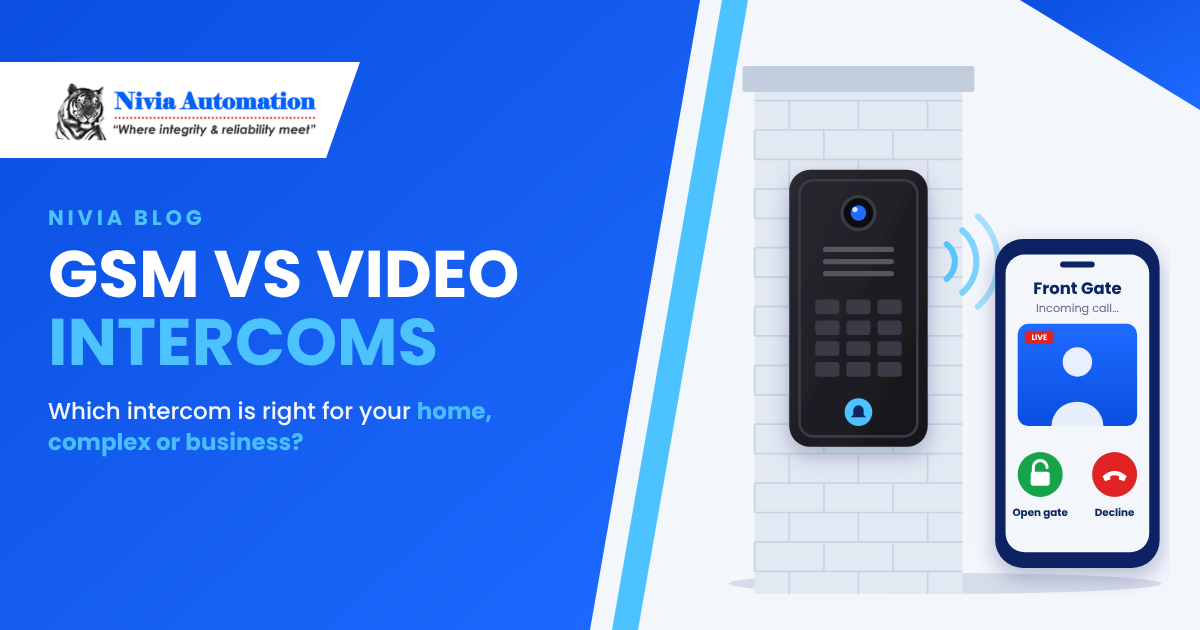
A video intercom adds a camera at the gate and a screen indoors, so you can see the visitor before you speak to them or let them in. Many newer models also connect to Wi-Fi, so you can answer and open the gate from an app on your phone.

  • Best for: family homes, complexes and offices where you want to see who’s there.
  • Pros: you can identify visitors, many models record snapshots or video, and app models work away from home.
  • Cons: costs more and needs cabling (and Wi-Fi for app control).

3. GSM intercoms

A GSM intercom works like a cellphone at your gate. It takes a SIM card, and when a visitor presses the button it calls your phone. You speak to them and open the gate from wherever you are, at work, on holiday or in the back garden.

  • Best for: properties with a long driveway, homes where nobody is in during the day, small businesses and farms.
  • Pros: no cable to the house, answer from anywhere, and authorised numbers can often open the gate with a call.
  • Cons: needs good cellphone signal at the gate and a SIM with airtime or a contract.

Intercom comparison at a glance

Audio Video GSM
See the visitor No Yes No (audio only)
Answer away from home No App models only Yes
Cable to the house Yes Yes No
Running cost None None (Wi-Fi for app) SIM airtime / contract
Ideal for Budget homes Homes, complexes, offices Busy homeowners, long driveways, businesses

Which intercom is right for you?

Freestanding home

If someone is home most of the day, a video intercom gives you the most peace of mind. If the house is often empty, or the gate is far from the front door, a GSM intercom means you never miss a delivery or a visitor.

Townhouse complex or estate

Complexes need a multi-unit system where each unit has its own button and indoor station or phone number. Video intercoms linked to access control (tags, keypads or remotes) give the best control over who comes in.

Office, warehouse or farm

GSM intercoms are popular here because there is no long cable run to install. Calls can go to reception, a manager or a rotating list of numbers.

What to check before you buy (South African tips)

  • Loadshedding: make sure the intercom and gate motor have a battery backup, so you can still answer and open the gate when the power goes off.
  • 2G and 3G switch-off: networks are phasing out 2G and 3G. If you’re choosing a GSM intercom, go for a 4G/LTE model so it keeps working.
  • Signal at the gate: test cellphone signal at the exact spot the GSM unit will go. A weak signal means dropped calls.
  • Lightning and surges: cables between the gate and the house can carry surges into your intercom and gate motor. Surge protection and proper earthing help prevent damage during summer storms.
  • Works with your gate motor: your intercom should trigger your existing gate motor cleanly. Our technicians check this as part of every installation.

Signs your intercom needs a repair or upgrade

  • Crackling, faint or one-way audio
  • The gate doesn’t open when you press the release button
  • A blurry or blank video screen
  • Your GSM intercom has stopped calling, or calls drop
  • Faded or broken buttons, or water damage to the gate unit

Many faults are quick fixes, such as a battery, a connection or a weather-damaged button. If your unit is old or 2G/3G-only, an upgrade is often better value than repeated repairs.

Intercom installation and repairs by Nivia Automation

Nivia Automation has installed and maintained intercom systems since 2004. We supply, install and repair audio, video and GSM intercoms for homes, complexes and businesses, using our own trained technicians in Johannesburg, Durban and Cape Town, not subcontractors.


Need a new intercom or a repair?

Call your nearest branch or request a free quote.

Johannesburg: (011) 485 1792  |  Durban / KZN: (031) 409 3718  |  Cape Town: (021) 633 0507


Frequently asked questions

What is a GSM intercom?

A GSM intercom uses a SIM card instead of cables to the house. When a visitor presses the button at the gate, it calls your cellphone (or a list of numbers), so you can talk to them and open the gate from anywhere you have signal.

Do GSM intercoms work during loadshedding?

The intercom keeps working if it has a battery backup, which we fit as standard. During long outages some cellphone towers can lose power, so calls may drop in certain areas. A gate motor and intercom on good batteries give you the best chance of staying connected.

Can I open my gate from my phone?

Yes. GSM intercoms let you open the gate during a call or, on most models, by calling the unit from an authorised number. App-based video intercoms let you see the visitor and open the gate from the app.

Will my old GSM intercom stop working when 2G and 3G are switched off?

It might. South African networks are phasing out 2G and 3G, so older units that only support those networks can lose service. We can check your unit and upgrade it to a 4G/LTE model if needed.

Do you install intercoms for complexes, estates and offices?

Yes. We install multi-unit intercom systems for townhouse complexes, estates and commercial buildings, including video intercoms linked to access control.

Do you repair intercoms you did not install?

Yes. Our own technicians repair and service most common intercom brands in Johannesburg, Durban and Cape Town.
Gate Automation

Gate Motor Installation Cost SA

Thinking about automating your gate, or replacing a motor that keeps failing? The first question most homeowners ask is simple: how much will it cost? This guide gives you realistic 2026 price ranges for gate motor installation in South Africa, explains what is included, and shows which factors push the price up or down. That way you can compare quotes properly and avoid surprises.

Quick answer

Most South African homes pay roughly R8,000 to R15,000 to have a residential sliding gate motor supplied and installed. Swing gate motors usually cost more, especially for double gates. Labour alone typically ranges from about R1,500 to R5,000, depending on how much work the site needs.

Gate motor installation cost in South Africa: 2026 price guide

The table below shows typical market ranges, including VAT. Your own price depends on your gate, your property and the motor you choose, so treat these figures as a guide rather than a quote.

Installation type Typical cost (supplied & installed)
Residential sliding gate motor (e.g. Centurion D5 Evo, ET Drive) R8,000 – R15,000
Single swing gate motor R9,000 – R12,000
Double swing gate motors (pair) R13,000 – R20,000+
Heavy-duty / commercial sliding motor (e.g. Centurion D10) R15,000 – R25,000+
Labour only (you already have the motor) R1,500 – R5,000

Prices are indicative market ranges for 2026 and change with supplier pricing. A site visit is the only way to get an exact figure.

What a standard gate motor installation includes

When you compare quotes, check that each one covers the same items. A proper residential sliding gate installation normally includes:

  • The gate motor and its control card
  • A base plate or foundation for the motor
  • Gear rack fitted along the length of the gate
  • A backup battery so the gate works during loadshedding
  • Two remotes, coded to the motor
  • Connection to an existing power point near the gate
  • Setting the open and close limits, speed and safety settings
  • Testing and a handover, so you know how to use the system

Anything outside this list, such as new cabling, trenching, safety beams or an intercom, is usually quoted as an extra.

7 factors that affect the price of your gate motor

1. Sliding or swing gate

Sliding gates need one motor and a rack, so they are usually the cheaper option. Swing gates need a motor per leaf, which is why a double swing gate costs noticeably more.

2. Gate weight and length

Every motor has a maximum gate weight. For example, the Centurion D5 Evo SMART is rated for sliding gates up to 500kg. A heavy steel gate may need a stronger, more expensive motor. Choosing a motor that is too small leads to strain, overheating and early failure.

3. Brand and model

Established brands such as Centurion, Nice, Hansa and ET cost a little more upfront. However, spares are easy to find, so repairs stay quick and affordable for years. Read our guide to choosing the right gate motor for a full comparison.

4. Power supply to the gate

If there is already a plug point close to the gate, installation is simple. If an electrician needs to run new cable or dig a trench across the driveway, expect the cost to go up.

5. The condition of your gate

A motor can only move a gate that runs smoothly. Worn wheels, a bent track or a gate that sags will need fixing first. Skipping this step is one of the main reasons new motors fail early.

6. Battery backup

All residential motors include a standard battery, but homes with long power outages often upgrade to a bigger battery or add solar. Our article on how long a gate motor battery lasts explains what size you need.

7. Security and convenience extras

Popular add-ons include an anti-theft bracket, safety beams, extra remotes, a keypad, a GSM module to open the gate from your phone, an intercom and surge protection. In summer storm season, surge protection is well worth it. See our guide to protecting your motor from lightning damage.

Repair or replace: is a new motor worth it?

A new motor is not always the answer. Many faults, such as a flat battery, a worn pinion or a faulty receiver, can be fixed for far less than a new installation. If your gate remote is not working, for example, the problem is often a cheap fix.

Replacing the motor usually makes sense when:

  • The motor is old and spares are no longer available
  • You are paying for repairs several times a year
  • Lightning or a power surge has damaged the control card and motor
  • Your gate is heavier than the motor is rated for
  • You want smart features, such as app control or diagnostics

Not sure which option is right? Our article on common gate motor problems and solutions can help you decide.

Hidden costs to watch for in a cheap quote

A low price can turn expensive if important items are missing. Before you accept a quote, check for these:

  • No anti-theft bracket. Gate motors are a common target for theft, so an unprotected motor is a risk.
  • Unknown brand. Cheap imported motors can be hard to repair because spares are scarce.
  • Undersized battery. Your gate may stop working halfway through a long outage.
  • Gate repairs left out. If the gate does not run smoothly, the new motor will struggle.
  • Subcontracted labour. Ask who will actually do the work and who you call if something goes wrong.
  • Call-out and travel fees. Check whether these are included or charged separately.

How to get an accurate gate motor quote

You can speed up your quote by sending us a few details:

  1. Is your gate sliding or swing? Single or double?
  2. Roughly how wide is it, and is it steel, aluminium or wood?
  3. Is there a plug point near the gate?
  4. Do you have an existing motor? If so, which brand?
  5. Two or three photos of the gate, track and motor area

A Nivia technician then checks the gate on site, and you get a clear written quote before any work starts.

Gate motor installation in Johannesburg, Durban and Cape Town

Nivia Automation has installed and repaired gate motors since 2004. Unlike many installers, we never send subcontractors. Every job is done by our own technicians, who carry spares for Centurion, Nice, Hansa and ET motors, so most repairs are finished on the first visit.

Frequently asked questions

How much does it cost to install a gate motor in South Africa?

Most homes pay roughly R8,000 to R15,000 for a residential sliding gate motor, supplied and installed. Swing gates, heavy gates and extras such as safety beams or an intercom increase the price.

Is installation included in the price of a gate motor?

Not always. Online and retail prices are usually for the motor or kit only. Professional installation typically adds R1,500 to R5,000, depending on the work needed.

How long does a gate motor installation take?

Most standard sliding gate installations are completed in a day. Jobs that need gate repairs, new cabling or trenching can take longer.

Can I install a gate motor myself?

It is possible, but we do not recommend it. Manufacturers state that motors should be installed by a suitably qualified technician. Incorrect setup can damage the motor, void the warranty and create a safety risk, especially with the gate’s force and obstacle settings.

Will my gate motor work during loadshedding?

Yes. Gate motors run off a backup battery, so they keep working when the power is off. If your gate slows down or stops during long outages, the battery may need replacing or upgrading.

Get a clear, written gate motor quote

Tell us about your gate and we will send a technician from our Johannesburg, Durban or Cape Town team. No subcontractors, no surprises.

Johannesburg: (011) 485 1792  |  Durban: (031) 409 3718  |  Cape Town: (021) 633 0507
After hours: 087 805 9781

Motor Repairs

Gate Motor Lightning Damage: How to Protect Your Motor


Quick answer: Most gate motor lightning damage doesn’t come from a direct strike. It comes from a power surge travelling through the mains cable, the underground wiring or the earth. Proper earthing, surge protection and a healthy battery backup are the best defence. If your gate stops working after a storm, switch off the power at the isolator and call a technician before resetting anything.

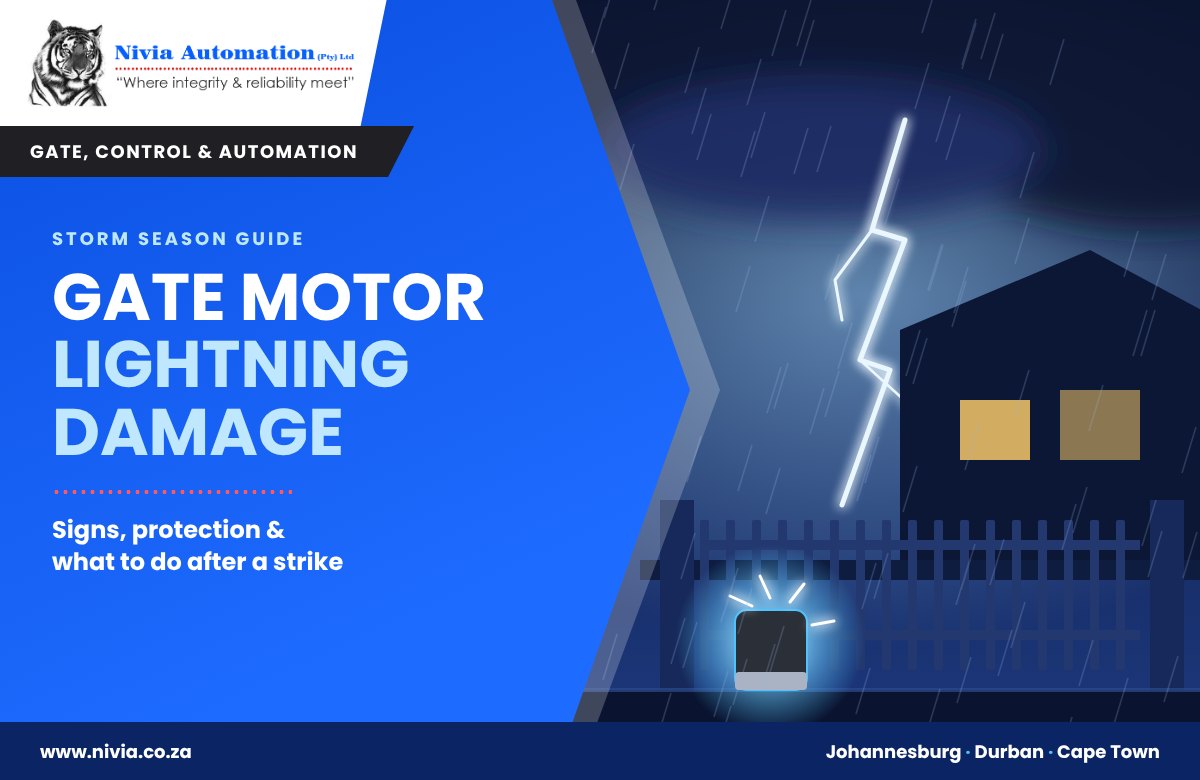
Summer storm season is here. From October to March, afternoon thunderstorms roll across Johannesburg, Pretoria and much of KwaZulu-Natal, and every year we see the same thing: gate motors that worked perfectly in the morning are dead by evening. Here’s what causes gate motor lightning damage, how to spot it and how to protect your motor before the next storm.


How lightning damages a gate motor

A gate motor sits outside, at the end of a long cable run, often close to an electric fence and a metal gate. That makes it an easy path for a power surge. Damage usually happens in one of three ways:

  • Mains surge: a strike on nearby power lines sends a spike down the cable that feeds your motor’s charger.
  • Ground surge: a strike close to your property raises the voltage in the soil, which travels through the earth and into buried cables.
  • Induced surge: a nearby strike creates a surge in long cable runs, such as intercom, keypad and safety beam wiring.

The parts that suffer most are the control card (the motor’s “brain”), the battery charger and the remote receiver. The motor itself often survives.


Signs of gate motor lightning damage

After a storm, look out for:

  • The gate won’t open or close at all, even on battery power
  • Remotes have stopped working, but the motor still hums or clicks
  • The status light on the control card is off, flashing an unusual pattern, or the card smells burnt
  • The battery isn’t charging and runs flat within a day or two
  • The intercom, keypad or safety beams stopped working at the same time
  • Your electric fence energiser also went off during the storm

How to protect your gate motor from lightning

Protection What it does
Proper earthing Gives a surge a safe path into the ground instead of through your electronics
Surge protection on the mains supply Absorbs spikes before they reach the charger and control card
Surge protection on low-voltage cables Protects the control card from surges on intercom, keypad and beam wiring
A healthy battery Keeps the gate running when the power trips during a storm
Regular servicing Picks up corroded connections and failing parts before a storm finds them

A few habits help too:

  1. Check your earthing. A loose or corroded earth connection leaves your motor unprotected. Our technicians check it as part of every service.
  2. Ask about surge protection. Your existing motor can often be fitted with surge protection, which costs far less than a new control card.
  3. Look after your battery. A weak battery means you can’t open the gate when the power fails mid-storm. Read our guide on how long a gate motor battery lasts.
  4. Keep the area clear. Water pooling around the motor base and ants nesting inside the cover both cause faults that storms make worse.
  5. Switch off before a big storm if you’re away. If you’re leaving for the holidays, switching off the motor’s mains isolator removes one route for a surge. The battery will still run the gate for a while.

What to do if your gate motor is hit by lightning

  1. Switch off the power at the isolator before touching the motor. Water and surge damage can make parts live.
  2. Don’t keep resetting it. Repeated attempts on a damaged control card can make things worse.
  3. Open the gate manually using the release key so you can get in and out safely.
  4. Take photos of the motor, the control card and any burn marks.
  5. Call a technician. We’ll test the control card, charger, battery and receiver and tell you what needs replacing.

For other faults, see our guide to common gate motor problems and solutions.


Is gate motor lightning damage covered by insurance?

Manufacturer warranties usually exclude lightning and power-surge damage. Many household and building insurance policies do cover it, but check your policy. Your insurer will normally ask for a technician’s report confirming the cause of the damage and a quote for the repair. We can provide both.


Frequently asked questions


Can lightning damage a gate motor if it doesn't hit the house?

Yes. Most gate motor lightning damage comes from power surges through the power lines or the ground after a strike nearby, not from a direct hit.


Will a battery backup protect my gate motor from lightning?

No. A battery keeps the gate working during power cuts, but it doesn’t stop a surge. You need proper earthing and surge protection for that.


Do I need a new gate motor after a lightning strike?

Not always. Often only the control card, charger or receiver needs replacing. We carry spares for Centurion, Nice, Hansa and ET motors, so most repairs are done on the first visit.


Is gate motor lightning damage covered by insurance?

Manufacturer warranties usually exclude it, but many household and building policies cover lightning and power-surge damage. Your insurer will normally ask for a technician’s report and a repair quote, which we can provide.


Can you repair my gate motor after hours?

Yes. For urgent faults outside office hours (Monday to Friday, 8am to 5pm), call our after-hours line on 087 805 9781.


Get your gate motor storm-ready

Nivia Automation’s own technicians install, repair and service gate motors in Johannesburg, Durban and Cape Town. Book a service before the storms peak, or call us if your motor has already been hit.
Johannesburg: (011) 485 1792
Durban: (031) 409 3718
Cape Town: (021) 633 0507
After hours: 087 805 9781


Battery Replacement

How Long Does aGate Motor Battery Last?

How Long Does a Gate Motor Battery Last?

Quick answer: In South Africa, most gate motor batteries last between 1 and 3 years, with 2 years being a realistic average. Frequent load shedding shortens that further, often down to 18–24 months, because every power cut forces the battery through another full charge cycle. The motor itself can easily last 8–15 years — it’s almost always the battery that needs attention first.

Why the battery wears out long before the motor

Most gate motors — including the Centurion, ET Nice, Hansa, and Nice systems we install and service — are actually designed to run primarily off the battery, even when mains power is available. The transformer’s job is simply to keep that battery topped up. So the battery isn’t just a “backup” for load shedding — it’s doing the work every single time your gate opens.

A standard sealed lead-acid battery has a design life of roughly 150 charge cycles. Under stable power, that can take a couple of years to use up. But every load shedding outage counts as a full charge cycle of its own. At two outages a day, that 150-cycle lifespan can be used up in a matter of months during heavy load shedding periods — which is why so many gate batteries in South Africa die well before homeowners expect them to.

What type of battery does your gate motor use?

Most residential gate motors use a 12V sealed lead-acid (SLA) or gel battery, typically rated at 7Ah or 8Ah. Larger sliding gate motors built for heavier gates (like the Centurion D6 or D10) run on 24V and use two batteries wired together.

  • Sealed lead-acid (SLA): the most common, most affordable option, but the least tolerant of repeated deep discharging from load shedding.
  • Gel batteries: a step up in durability, generally better suited to frequent charge cycles.
  • Lithium-ion (LiFePO4): higher upfront cost, but can significantly outlast lead-acid or gel batteries and copes far better with heavy load shedding cycling — often the better long-term value in areas with frequent outages.

What affects how long your gate motor battery lasts

  • Frequency of use — the more your gate opens and closes each day, the faster the battery wears
  • Load shedding and power cuts — every outage is another full discharge/recharge cycle
  • Heat — a motor housing that sits in direct sun ages the battery faster than one in the shade
  • Battery type — SLA, gel, and lithium batteries all age differently under the same conditions
  • Maintenance — clean terminals and secure connections go a long way toward getting a battery’s full expected life

Signs your gate motor battery needs replacing

  • The gate opens or closes noticeably slower than it used to
  • The gate stops partway and doesn’t fully open or close
  • The gate only works while mains power is on, and stops completely during load shedding
  • The remote works, but the gate is slow or hesitant to respond
  • The motor makes a clicking sound but the gate doesn’t move

If any of these sound familiar, it’s worth having the battery checked before it fails completely — usually at the worst possible time, like being locked out during load shedding.

How load shedding affects your gate motor battery

Because every outage forces a full charge cycle, the stage of load shedding your area experiences has a direct, measurable effect on how long your battery lasts:

Load shedding level Typical battery lifespan
Light / occasional 24–36 months
Frequent 18–24 months
Heavy daily cycling (e.g. high-traffic complex gates) Often under 18 months

How to get more life out of your gate motor battery

  • Keep the battery terminals clean and the connections tight — corrosion is one of the most common hidden causes of “battery” problems
  • Keep the motor housing out of prolonged direct sun where possible
  • Don’t wait for a full failure — replace proactively once you notice slowing, rather than risking being locked out
  • If your area sees frequent load shedding, consider a gel or lithium-ion battery over standard SLA
  • Have the battery load-tested as part of a regular service (ideally every 3–4 months) rather than only checking it once something goes wrong

Which replacement battery is right for your gate motor?

  • SLA — cheapest upfront, shortest realistic life in a load shedding environment
  • Gel — a modest step up in cost, meaningfully better deep-cycle tolerance
  • Lithium-ion (LiFePO4) — the highest upfront cost, but often works out cheaper over time in high-load-shedding areas since it can outlast two or three lead-acid replacements

Nivia Automation supplies and fits the correct battery for Centurion, ET Nice, Hansa, and Nice gate motors, and can advise on whether upgrading to gel or lithium makes sense for your property and how often your area experiences load shedding. Not sure which is right for you? See our Gate Automation services or get in touch for a free assessment.

Frequently asked questions

How do I know if it's the battery or the motor that's faulty?

If the gate is slow, doesn’t fully open or close, or only works with mains power connected, it’s almost always the battery. True motor faults are less common and usually come with grinding noises, burning smells, or the motor not engaging at all.

Can I replace a gate motor battery myself?

It’s a fairly simple swap on most motors, but it’s worth having it done by a technician who can also check the charging circuit and terminals — a new battery on a faulty charging system will fail again quickly.

How long will my gate work on battery backup during an outage?

Most residential setups give roughly 4–6 hours of standby power, or around 10 full open-close cycles, depending on gate size, battery condition, and motor settings.

How much does a gate motor battery replacement cost?

It depends on your gate motor brand, battery type, and whether you’re upgrading to gel or lithium. Get in touch for a free, no-obligation quote.

Get a Free Gate Motor Battery Quote

If your gate has been slow to respond, or stops working the moment load shedding hits, it’s very likely your battery — not your motor. Nivia Automation services and supplies batteries for Centurion, ET Nice, Hansa, and Nice gate motors across Johannesburg. Fill in the form and we’ll get back to you with a free quote.

Certificates

Certificate of Compliance When Buying or Selling a House

Introduction

Buying or selling a house is a significant financial and legal transaction that involves various critical steps to ensure a smooth and hassle-free process. One crucial aspect often overlooked by many is obtaining a Certificate of Compliance. In this article, we’ll delve into the importance of a Certificate of Compliance when buying or selling a house and how Nivia Automation can be your trusted partner in navigating this essential requirement.

Understanding the Certificate of Compliance

A Certificate of Compliance is a vital document that verifies whether a property complies with various legal and safety standards established by local authorities and regulatory bodies. It ensures that the property adheres to necessary regulations regarding electrical, plumbing, gas, and other safety measures. When selling a house, providing a Certificate of Compliance reassures the buyer that the property is in good condition and meets all necessary codes.

Importance for Buyers

For potential homebuyers, obtaining a Certificate of Compliance adds an extra layer of assurance. It guarantees that the property they are considering is up to code, reducing the risk of unexpected repairs or safety hazards. This certificate provides peace of mind that the investment they’re making is sound and that they won’t face any legal or financial consequences due to non-compliance issues.

Importance for Sellers

On the seller’s side, presenting a valid Certificate of Compliance can significantly enhance the marketability of the property. It portrays a professional image and establishes trust between the buyer and the seller. A home with a Certificate of Compliance is more likely to attract potential buyers and can potentially fetch a higher selling price due to the reduced concerns about hidden issues.

Nivia Automation: Your Trusted Partner

When it comes to acquiring a Certificate of Compliance, Nivia Automation stands out as a reliable partner. With years of experience in property compliance automation, Nivia Automation offers a seamless solution that simplifies the process for both buyers and sellers. Their advanced technology streamlines the often intricate compliance procedures, saving time and reducing stress.

How Nivia Automation Works

  1. Effortless Inspection: Nivia Automation’s expert team conducts thorough property inspections to ensure all compliance standards are met.
  2. Documentation: They gather all necessary documentation and records, ensuring a comprehensive compliance history for the property.
  3. Quick Turnaround: Nivia Automation expedites the certification process, providing buyers and sellers with the necessary certificates promptly.
  4. Expertise: With a deep understanding of local regulations, Nivia Automation ensures that properties adhere to specific requirements in your area.
  5. Transparent Reporting: They provide transparent and detailed reports, highlighting any areas that need attention before certification.

Conclusion

In the world of real estate, transparency, safety, and compliance are paramount. Whether you’re a buyer or a seller, obtaining a Certificate of Compliance is a critical step in ensuring a successful and secure property transaction. Nivia Automation’s commitment to simplifying this process through their expert services positions them as a valuable partner for anyone navigating the complexities of property compliance. Embrace the peace of mind that comes with a certified property and partner with Nivia Automation today for a seamless, compliant, and stress-free property transaction experience.

certificate of compliance

Contact us for a quote

Facebook | Twitter | Instagram

Garage Automation

Expert Garage Door Motors Installation | Fast & Reliable

Introduction

Installing a garage door motor is a game-changer for homeowners seeking convenience and security. A motorized garage door offers seamless automation, allowing you to open and close your garage with just a push of a button. However, to ensure a successful installation that guarantees smooth operation and longevity, it’s essential to follow the right steps and enlist the help of professionals.

Assess Your Garage Door:

Before diving into the installation process, inspect your garage door to determine its size, weight, and condition. Different motors are designed for specific door types, so understanding your garage door’s specifications is crucial to choose the appropriate motor.

Select the Right Motor:

Garage door motors come in various types, such as chain-driven, belt-driven, and screw-driven. Each has its pros and cons, affecting noise levels and maintenance requirements. Research and select the motor that best suits your needs and budget.

Gather the Necessary Tools:

Ensure you have all the required tools for a smooth installation process. Common tools may include a drill, screwdrivers, pliers, and a ladder.

Read the Manufacturer’s Instructions:

Thoroughly read the installation manual provided by the manufacturer. Following the instructions step-by-step will help you avoid mistakes that could lead to malfunctions or accidents.

Safety First:

Garage doors are heavy and can be dangerous during installation. Always prioritize safety by wearing protective gear, such as gloves and safety glasses. Enlist a friend or family member to assist you with handling heavy parts.

Install the Motor Unit:

Attach the motor unit to the ceiling, following the manufacturer’s guidelines. Ensure it is securely fastened to avoid vibrations during operation.

Install the Rail and Trolley:

Attach the rail to the motor unit and the trolley to the garage door. Adjust the chain or belt tension according to the instructions.

Test the Safety Features:

Modern garage door motors come with safety features like auto-reverse and infrared sensors. Test these features to make sure they are functioning correctly.

Connect the Remote Control:

Pair the remote control with the motor unit and test its functionality. Some motors may be compatible with smart home systems for added convenience.

Conclusion:

A properly installed garage door motor enhances your daily life, offering convenience and peace of mind. While some homeowners may choose to attempt the installation themselves, it’s always best to seek professional assistance for a safe and efficient setup. Investing in a reputable installation service ensures that your garage door motor operates flawlessly for years to come, giving you one less thing to worry about.

garage door motors

Contact us for a quote

Facebook | Twitter | Instagram

Electric Fencing

How Advanced Electric Fencing Enhances Security

Introduction

At Nivia, we understand the significance of security in today’s world. In this comprehensive guide, we will delve into the innovative world of advanced electric fencing and how it can significantly enhance security measures for residential and commercial properties alike. Electric fencing has proven to be a formidable deterrent against intruders, ensuring that your property remains protected at all times.

Understanding Electric Fencing

Electric fencing is a highly effective security solution that involves the use of electric currents to create a non-lethal but powerful deterrent against potential trespassers. This type of fencing is constructed using a series of interconnected wires, carrying a controlled electrical pulse that serves as a barrier to unauthorized entry.

Benefits of Electric Fencing

Electric fencing offers a multitude of benefits that set it apart from traditional fencing methods. Some of the key advantages include:

  1. Enhanced Security: Electric fencing provides an active defense mechanism that creates a psychological barrier, deterring potential intruders from attempting to breach the perimeter.
  2. Customization: The versatility of electric fencing allows for tailored solutions to fit the unique security requirements of each property.
  3. Remote Monitoring: Advanced electric fencing systems can be integrated with surveillance technology, enabling remote monitoring and real-time alerts in the event of a breach.
  4. Minimal Maintenance: Electric fences are constructed using durable materials, resulting in low maintenance costs compared to other security measures.

Advanced Electric Fencing Technology

Over the years, the technology behind electric fencing has evolved significantly, resulting in more sophisticated and reliable systems. Here are some of the cutting-edge features that propel modern electric fencing solutions:

1. Electric Fence Energizers

The heart of any electric fence is the energizer, also known as the electric fence charger. These devices generate the electrical pulses that flow through the fencing wires. Advanced energizers offer intelligent monitoring, self-diagnostic capabilities, and low power consumption for increased efficiency.

2. Zone-specific Alarms

Integrating zone-specific alarms allows property owners to identify the exact location of a breach. This feature enables a faster response time, enhancing the overall security of the property.

3. Wireless Connectivity

With the advent of wireless technology, electric fencing systems can now be controlled and monitored remotely. This connectivity ensures that property owners stay informed about the security status even when they are not physically present.

Installation and Maintenance

To ensure optimal performance, it is essential to have your electric fencing professionally installed and maintained. Improper installation can lead to inefficiencies and compromises in security.

  1. Selecting the Right Service Provider

Choosing the right service provider is crucial for a successful electric fencing installation. Look for experienced professionals with a proven track record in delivering reliable and robust security solutions.

  1. Regular Maintenance Checks

Scheduled maintenance checks are imperative to keep the electric fencing system in top-notch condition. Trained technicians can identify and rectify any issues promptly, ensuring the system operates at its full potential.

Advanced Electric Fencing

Contact us for a quote

Facebook | Twitter | Instagram

Electric Fencing

Expert Electric Fencing Repairs: Fast & Reliable Service

Introduction

Electric fencing serves as a crucial component in safeguarding properties and ensuring the security of both residential and commercial spaces. However, like any other system, electric fences may require occasional repairs due to wear and tear, weather conditions, or unforeseen incidents. This article aims to shed light on the importance of timely electric fencing repairs and the benefits they offer in maintaining a secure environment.

  1. The Significance of Electric Fencing Repairs: Electric fences act as a strong deterrent against intruders, protecting your property from unauthorized access. Regular maintenance and prompt repairs ensure the system operates at optimal levels, preventing vulnerabilities and minimizing security risks. By addressing issues promptly, you can uphold the integrity of your electric fence and safeguard your property effectively.
  2. Identifying Common Repair Needs: Various factors can lead to electric fencing issues, including broken wires, damaged insulators, malfunctioning energizers, or faulty connectors. Recognizing these common repair needs is crucial in determining when professional assistance is required. Conducting regular inspections and addressing any signs of damage promptly will help maintain the reliability of your electric fence.
  3. Importance of Professional Electric Fence Repair Services: While some minor repairs can be handled by property owners, it is recommended to seek professional assistance for complex or extensive issues. Professional electric fencing repair services have the expertise, tools, and knowledge to diagnose and resolve intricate problems efficiently. Their experience ensures comprehensive repairs, reducing the risk of further damage and ensuring long-term reliability.
  4. Benefits of Timely Repairs: Timely repairs restore the full functionality of your electric fence, ensuring it acts as a robust security measure. With a properly functioning fence, potential intruders are deterred, providing peace of mind for property owners.
  5. Maintenance Tips for Longevity: To extend the lifespan of your electric fence, consider implementing the following maintenance practices: Conduct routine inspections to identify any signs of wear, damage, or malfunctions, Keep the fence area clear of debris, Regularly test the voltage levels, Check and tighten all connections, Maintain a record of repairs and maintenance.

Conclusion

Electric fencing repairs are a vital aspect of maintaining the security and effectiveness of your property’s perimeter protection. By promptly addressing issues, seeking professional assistance when needed, and following recommended maintenance practices, you can ensure the longevity and reliability of your electric fence. Prioritize the safety and security of your property with regular electric fencing repairs, guaranteeing peace of mind for you and your loved ones.

electric fencing repairs

Contact us for a quote

Facebook | Twitter | Instagram

Motor Repairs

Expert Gate Motor Repairs in Sandton

Are Looking For Expert Gate Motor Repairs In Sandton: Look No Further

Introduction

If your gate motor is malfunctioning or not working at all, it’s essential to have it repaired by a reliable and experienced technician. Our team of experts specializes in gate motor repairs in Sandton, ensuring that your gate operates smoothly and safely. In this article, we’ll cover common gate motor problems, how to troubleshoot them, and why it’s important to seek professional repairs.

Looking for gate motor repairs in Sandton

  1. Common gate motor problems and their causes
  2. Troubleshooting tips for DIY repairs
  3. Why professional gate motor repairs are necessary
  4. The benefits of regular maintenance for your gate motor
  5. Why choose our team for your gate motor repairs in Sandton

Signs that Your Gate Motor Requires Repairs

Detecting early signs of gate motor problems is crucial to prevent further damage and costly replacements. Look out for the following indicators:

  1. Unusual Noises: Grinding, screeching, or clicking sounds when operating the gate.
  2. Slow Response: Delayed opening or closing of the gate after activating the remote.
  3. Gate Misalignment: The gate may not close evenly or struggles to reach the fully closed position.
  4. Physical Damage: Visible damage to the gate motor, such as rust, cracks, or loose components.
  5. Electrical Issues: Frequent tripping of circuit breakers or erratic behavior of the gate motor’s control panel.

Our Expert Gate Motor Repair Services

As a trusted provider of gate motor repairs in Sandton, we take pride in delivering top-notch services that prioritize the functionality and security of your gate system. Our team of skilled technicians possesses extensive experience in diagnosing and resolving various gate motor issues promptly.

Comprehensive Inspection and Diagnostics

We commence each repair project with a thorough inspection of your gate motor system. Our experts meticulously examine every component, from the motor itself to the control panel and remote systems, to identify underlying problems accurately.

Swift and Precise Repairs

Once the issues are pinpointed, our team swiftly gets to work, using their expertise and state-of-the-art tools to execute repairs with precision. Whether it’s replacing faulty components, fixing electrical connections, or addressing alignment concerns, we handle it all to ensure your gate motor functions flawlessly.

Quality Replacement Parts

At our repair center, we source only genuine and high-quality replacement parts for gate motors from reputable manufacturers. This guarantees the longevity and reliability of your gate system after repairs, reducing the likelihood of recurring problems.

Proactive Maintenance Tips

Beyond repairs, we believe in empowering our clients with knowledge to maintain their gate systems effectively. Our article “The Ultimate Guide to Gate Motor Maintenance” offers proactive maintenance tips to extend the lifespan of your gate motor and enhance its performance.

Advantages of choosing gate motor repairs in Sandton

  1. Reliability: We have a proven track record of delivering dependable gate motor repair solutions to countless satisfied clients in Sandton.
  2. Prompt Service: We understand the urgency of gate motor repairs, and our team strives to provide quick and efficient service to minimize any inconvenience.
  3. Expert Technicians: Our skilled technicians have the expertise to tackle a wide range of gate motor issues, ensuring comprehensive and effective repairs.
  4. Customer Satisfaction: Our commitment to customer satisfaction drives us to exceed expectations and offer personalized solutions for every client.
Conclusion

Don’t let a faulty gate motor compromise your property’s security and convenience. Contact our team of experts in Sandton for reliable and efficient gate motor repairs.

Contact us for a quote

Facebook | Twitter | Instagram